The Visual Poetry of

A L I C E...T E I C H E R T

By Ken Carpenter


Reprinted from Artfocus/69, Summer/Fall 2000 ©Artfocus Magazine (Toronto)


Alice Teichert embraces
the artistic values of simplicity, immediacy and freedom, but her deceptively simple paintings have complex and disparate origins that are not always readily apparent. Throughout her career she has worked to integrate the various experiences,<1> those accumulated ìbackgrounds,î that have shaped her as an artist. Born in Paris in 1959, Teichert was raised in Brussels, where the first influence on her art came from her mother, a pianist, who taught her to play that instrument and to read music. Music became "an obsession," as that most abstract of art forms, with a notation that was both suggestive and visually engaging. To Teichert, the "fluidity" of music remains a value to which painting can still aspire.


Teichert transferred from the internationally oriented European School in Brussels to a high school with an intensive art programme and then went on to the Ecole Régionale des Beaux-Arts of Valence in France, where Pierre Soulages was a visiting artist and she made contact with critic Dominique Fourcade. Teichert was influenced by the so-called gesture painters, such as Henri Michaux, who to her exemplified painting and drawing as "visual forms of poetry." As a multi-lingual person fluent in French, German and English, Teichert was drawn to the study of language, as such, and she was soon reading French theorists: Barthes, Derrida, Saussure, and others favoured by the Post-Modernist movement. She observes that they "made me see the links between all languages spoken and written, and the (m)other tongue we all share,and they encouraged her also to think of painting in terms of "language" and "communication."

When she migrated to Canada in 1984, Teichert was creating visual poetry of a type that in France was called "visual readings," and she tended to move in literary circles. She soon met bp nichol at York University, and his example encouraged her to develop further her visual interpretation of poetry by "playing with words." To Teichert, poetry necessarily entails the relationship between words and the seemingly "blank" spaces between them. "In French," she writes, ìthere is a beautiful distinction between un espace and une espace: Un espace is the space where the type or word is placed; Une espace is the space between the words, which is the place where the rivers run [towards our understanding]. Both together make one.î This highly visual way of thinking about literature culminated in Teichert's limited-edition book of concrete poetry, j'eux (1998) in which she explored "the complexity of languages and the bridge of silence that opens the continuum of felt spaces."

On occasion Teichert has been tempted to tie painting to language in a more direct way. Cyndi Dale's book, New Chakha Healing (1996), provided her with a sort of dictionary of colour meanings: purple is for openness to the universe, yellow connotes the fire of the ego, and so on. But Teichert was determined not to do a merely symbolic abstraction, but rather "painting that is said but unsaid." She wants to avoid any "theoretic formulation" that would limit colour.

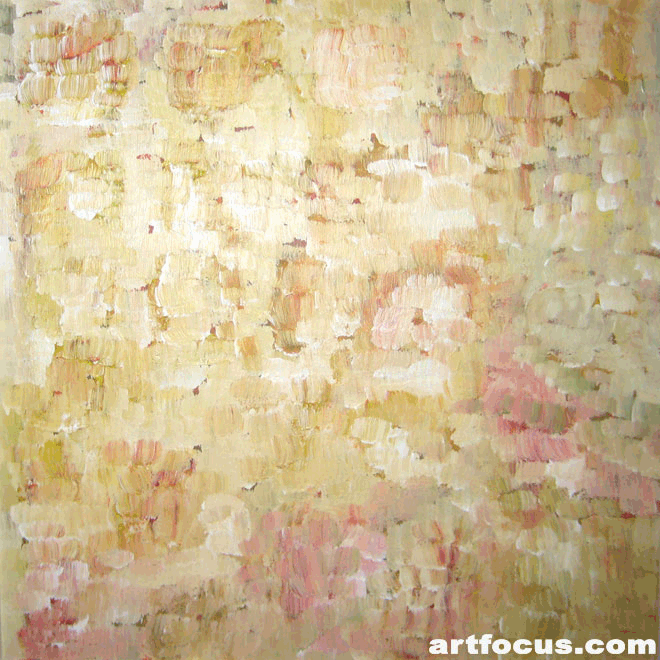
A chief motive for moving to the "new world" of North America had been Teichert's admiration for its abstract art. She was greatly stimulated by Jackson Pollock's retrospective at the Centre Georges Pompidou in 1982, and she was drawn to Rothko and Hofmann, Frankenthaler and Bush, as antidotes to her "well-encrusted" background with its "very classic" European training. Teichert shared with these Modernist masters a concern with the medium as a vital stimulus to creativity, and an intense interest in reconsidering the very nature of the basic vocabulary of visual art. Thus her paintings encompass a wide range of linear properties: there is gouged line, strokes of oil crayon, and what I can only call small chromatic caresses. Like her chosen artistic forebears, she foregrounds colour, which to Teichert is a "universal language." But technique, as such, is not her concern, and she rejects any tendency to value it for its own sake.

Teichert has especially appreciated Jack Bush's intuitive approach to the creative process: "The picture has to tell me" what to do," she says. Like Bush, as exemplified by his celebrated comment, "Well now, Mr. Yellow, what would you like next door?"<2> she starts with a colour she would like to work with, and then brings in another that she intuits should go with it. Bush's example thus provided one avenue for Teichert's "transfer" from the writing world to the painting world. For her, poetry and painting are like her spoken languages: she can choose which one to communicate with at any particular moment. By 1992 this "transfer" was largely complete, and she had the look of a highly accomplished Modernist painter, working in an allover vein (e.g., Organ Day) that was quite free from any literary concerns and in fact belied the complexity of her formative experiences -- the tension between high Modernism's abhorrence of the literary and Teichert's fascination with it.

In the last few years, Teichert has aimed for a symbiosis of these two directions. Not surprisingly then, the space of Teichert's current work is not quite the indeterminate and disembodied space of her Modernist sources. She lives in the Northumberland hills of Ontario with her husband, artist Bobby Tamo, and their two children, where she maintains an extensive garden, in a tradition most famously exemplified by Claude Monet. Images from that place are often suggested by elements within her paintings. She describes hers as "felt spaces," "from a place beyond description," and she aims for a kind of "anamorphosis," that is, the transformation of image into "traces" of her experience. Thus Teichert's is an art in which "all forms start shifting and become legible and illegible simultaneously."

Teichert's art is neither as detached nor as free from function as high Modernism has been thought to demand. She has observed that painting "allows me to collect myself... stay rooted." To her,"Painting is a fluid language that moves our souls," and abstraction, especially, is "a spiritual experience." Hence her admiration for Rudolph Steiner, with his "enlightened approach to his teaching, an awareness of that which can be felt or known but not proven --the spiritual."

Teichert's career has been distinguished by her willingness to tolerate, indeed embrace, seemingly opposed values: the focus on the medium of high Modernism versus the fascination with language of Post-Modernism; a considerable intellectual investigation versus the attempt "to master play," like a Chinese calligrapher. Her work has its distinctive genesis, emotional valence, and intrapsychic functions within her life.

To Teichert, abstraction is still full of promise, "at the embryo stage." As she says, "Writing guides me, painting wanders me." At one time she used to treat painting as a kind of notation. Before, she says, "I made things happen; now, I let things happen."


-30-


Author:
Ken Carpenter is Chairman of Visual Arts @ York University in Toronto. He is a member of the Canadian Branch of the International Association of Art Critics (AICA).

Captions:
<1>Alice Teichert, Mémoire, 2000, acrylic & oil stick
on canvas, 54 X 54î
<2>Alice Teichert,Fresh Air, 2000, acrylic & oil stick
on canvas, 59 7/8 X 30î
<3>Alice Teichert, Artesian Well, 2000, acrylic & oil stick
on canvas, 55 X 36î

Footnotes:
<1> Quotations from the artist come from her unpublished manuscript, Drawing after a Pictorial Language in the Image of Writing (ca.1992); her letter to the author of Oct.9, l999; interviews of June 5, l998 & July 9-10,2000 & her statement for the current exhibition @ Gallery One, Toronto, July 20- August 9, 2000.
<2>"Wendy Brunelle Talks with Jack Bush," in Jack Bush by Karen Wilkin (ed.) (Toronto: McClelland & Stewart, 1984), p.195. Bush added, "I am just thinking to myself."

Credit:
Photographs in the article courtesy Gallery One (Toronto).

Weblink:
Alice Teichert @
http://www.aliceteichert.com