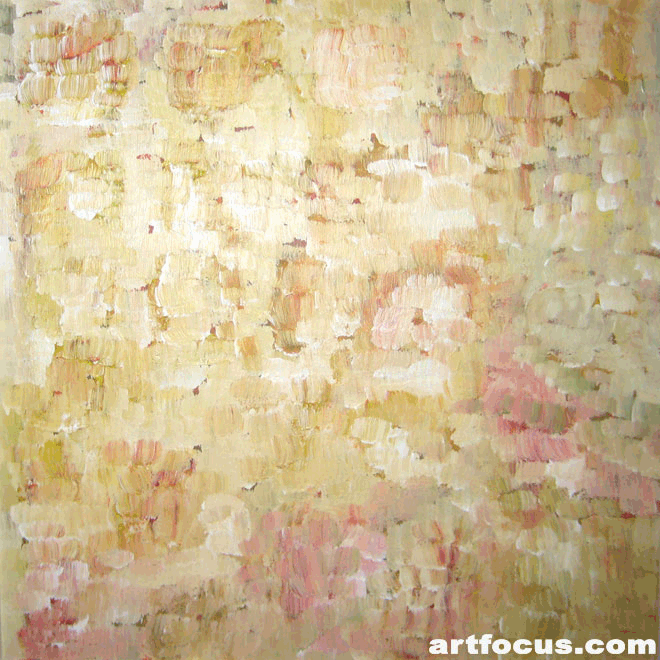
NEW NEW PAINTERS IN DENVER

The Medium is the Message

By Pat Fleisher

Reprinted from ARTFOCUS/66, Summer 1999 © ARTFOCUS MAGAZINE


Joseph Drapell
(Canadian) with Gates of Life,l998


Lucy Baker/El Nono,
1997


Jerald Webster/Bacchanal, 1997


Bruce Piermarini/Functional Fit, Diptych,l997


Marjorie Minkin/Anu 1997


Roy Lerner/Resolute 1997

Irene Neal/Blue Thunder l996


Graham Peacock (Canadian)
Rock Silver 1996/97

The Medium is the Message, Marshall McLuhan's catch phrase for the 20th century, is the most apt description of the NEW NEW PAINTERS. The group exhibit which opened at the Museum of Contemporary Art/Denver (MOCAD) in Denver, Colorado on April 30, 1999, (continuing to July 4), is the 2nd phase of a tour which began at the Flint Institute of Arts in Flint, Michigan from January 30 to April 18, l999.

The show was organized by Sue Scott and John Henry, Curators at the Flint Institute, with the assistance of Dr. Kenworth Moffett, (currently the MOCA/ Denver's Advisor/Director). Moffett added 14 new works to the exhibit between Flint and Denver. The 11 artists in this show included New England painters Lucy Baker, Steve Brent, John Gittins, Roy lerner, Anne Low, Marjorie Minkin, Irene Neal, Bruce Piermarini and Gerald Webster and Canadians Joseph Drapell (born in Czechoslovakia and living in Toronto) and Graham Peacock (born in Britain and living in Edmonton).

The 5,000 square foot Museum of Contemporary Art/ Denver is situated in the former Granada Fish Market in Sakura Square, which has been converted into a functioning art gallery. Dedicated members of the Alliance for Contemporary Art, the volunteer museum staff and even community artists pitched in to transform the space barely six months ago. The museum is a bright light in the heart of a group of burgeoninging "alternate" artist's spaces, which co-exist amidst a twilight zone of iron-grated bars and pawnshops (much like the Parkdale area in Toronto), situated a few blocks from Denver's railway terminal, Union Station (same name as Toronto).

In the introspective mood of sadness that dominated the Denver news the opening weekend, barely two weeks after the Columbine High School massacre, NEW NEW was like a beam of positive energy: the built-up three-dimensional paintings in vivid day-glo colours seemed almost to leap from the walls. "The NEW NEW group are the most vital and alive abstract artists I have met,î says Moffett, "each of these painters is able to deliver works with vitality, energy, joy and beauty.... each have a unique personal style.....but in their working methods (looking down and "pouring") they all look back to Jackson Pollock... they are very scary and ambitious people who enjoy bouncing ideas off each other competitively.... by fearlessly opening up to each other artistically, they have reached an energy level and sophistication that is in harmony.... the work is aggressive and expressive.... it's direct and very humanistic....."

Art has always been a reflection of the cultural energy of society. With the advent of Surrealism, Western art split into two directions: the literal and the non-literal projection of the human psyche. Like many retro-movements today, NEW NEW takes off from the abstract surrealists with a ìPost Postî Modernist energy. The artists incorporate ìPost-Popî and ìPost Neo-Geoî in their use of garrish ìkitschî materials like neon colours, fluorescent paints, sparkles and even holograms to make their paintings almost ìsnap, crackle and pop.î

How did the NEW NEW group evolve? Lucy Baker, the group's founding member and archivist explained, it began in New England in the early 80's with herself and Marjorie Minkin. They were experimenting with new acrylic mediums (thickening materials like gels) and fluorescent and interference colours. Baker started the Boston Painters group; she selected artists for shows, organized speakers and invited curator Ken Moffett (and later critic, Clem Greenberg) to critique the work of herself and others working in these materials. Graham Peacock was asked to join the group when Baker met him at an Emma Lake workshop in Saskatchewan; Joseph Drapell was introduced by Greenberg to Moffett when they came to Toronto for meetings on the Jack Bush Estate. An early "New Generation" show at Andre Emmerich Gallery in New York curated by Moffett, also included Torontonians Carol Sutton and Harold Feist, but they were basically "colour field" and "stain" painters, says Lucy, and did not fit the overall focus on textured surfaces of the NEW NEW painters.

Many of the works seen in this 1999 Denver show seemed to bridge the gap between sculpture and painting in their three-dimensional quality. In fact, for artists like Marjorie Minkin, cast shadows and translucence play a big part in appreciating the beauty of her torso-like wall pieces, as in free-form sculpture. Much like the architect Frank Gehry in his creation of the Guggenheim Bilbao Museum in Spain, Minkin uses Lexan, a clear polycarbonate plastic (a material developed for use in bullet-proof vests and airplane design), as her base. The material can be cut out and heated to give her the shape she desires, before colour is applied. Her newest piece was a life-size irridescent forest green torso shape, aptly titled Anu, Goddess of the Forest in Ireland.

Graham Peacock builds up his surfaces over a canvas backing, allowing a natural "crackle" effect in the drying process between different layers of acrylics applied wet on wet, to set up a richly textured topographical-like surface, which create artworks that seem almost like landscapes seen from an airplane. See
http://plaza.powersurfr.com/grahampeacockart

Irene Neal, on the other hand, uses a plywood base and ìpoursî layers of paint directly from one gallon buckets of clear gel (to which colour has been added) to create her highly coloured artworks; before the layers set, she uses a soup spoon to pick up sections and swirl them around to bring up the colours of the layers beneath.

Ann Low is a scuba diver and pilot; both these avocations give her paintings a sense of looking down at endless space which defies a sense of gravity.

Roy Lerner describes NEW NEW abstract painting as art that draws from the unconscious level; art that expresses deep feelings and thoughts that can't be translated into words. His own paintings are reminiscent of imaginary "other" places; you feel like figuration is about to happen...but it doesn't. His work relates to modern music, with a sense of movement and modulation on the surface... like the early Abstract Expressionists he likes to listen to jazz while he works and relates, he was a personal friend of Miles Davis.

The work of Jerald Webster is more measured and formal, amost Neo-Geo in his hard-edge use of repeated thick geometric forms in brilliant colours on each painting surface. Steve Brent is known for his thick, fan-like, shaped wall paintings, almost like sculptural reliefs... originally built up over rolled canvas, recently he has been experimenting with using tubes and plywood as a base for his undulating surfaces covered with brilliant irridescent gels and sparkles.

Bruce Piermarini tosses his paint in layers onto the canvas, then draws into the layered paint, using a rag attached to a stick on the end of it, to achieve blind-like effects. John Gittins mixes brilliant colours with gel in five gallon cans, then pours the colour into tubes and draws with them in thick tentacles squeezed onto the canvas, somewhat like a baker icing a cake.

Cover artist Joseph Drapell achieves his signature cordoroy effects by scraping into the gel surfaces of his paintings with various sized custom built steel combs.

But the total show was best summed up by Moffett in his intro speech in Denver when he said, ìto enjoy NEW NEW paintings you don't have to read a lot, you have to look a lot!î

Notwithstanding, NEW NEW enjoys a prestigious intellectual and international context. Paris art dealer Gerald Piltzer used the name for a handsome bi-lingual book published in l992, in conjunction with a European museum tour of the North American group (with the addition of several French painters) he organized in l993 and 1994. This aspect will likely be expanded, as French art critic and publisher Marcel Paquet joined the festivities in Denver and put forward the dramatic super-thick paintings of Belgian artist Bram Bogart as a possible future addition to the NEW NEW group.

Much like artists in the late 19th century embraced the perspective discoveries of photography as the newest artistic, breakthrough, NEW NEW summarizes the lively interractive involvement of artists in the 20th century with advances in technology, by expounding the use of plastics and found objects as art materials.

To quote from an early '90's New New Manifesto: "New materials demand a new direction... we are painting with pure plastic paint. We do not want to imitate oil paint... High Technologyí has given us a new world order and a new paint... no past material enabled us to substantiate the feelings of our time and formulate the vision and content of our lives... "

With this philosophy, the NEW NEW painters seem superbly poised to enter the high tech world of the 21st century with aplomb.


# # # #


Below


NEW NEW group @ The Cambridge Hotel, Denver, April 1999
L.to R: Ann Low (USA artist), Ken Moffett (curator),
Pat Fleisher (Canadian journalist) , Marcel Paquet
(Paris publisher), Irene Neal (USA artist), Gerard Paire
(visiting Paris NEW NEW artist).


Update 2000

'NEW NEW PAINTERS' IN NEW YORKwas shown
@ the'69th Regiment Armory, 26th & Lexington, New York City,
May 18-23, 2000. Exhibit sponsored by A.N.E.W.FOUNDATION FOR THE ARTS. Online @
www.anew.org

'NEW NEW PAINTERS' IN PRAGUE, @ The National Gallery in Prague, October 2000.


ARTFOCUS ONLINE

about us | newsletter | portfolios | magazine | art calendar |
crosslinks | art critics | art fairs | art books |
art recipes | art horoscopes | subscribe | e-mail